
Tracing
A long run is thousands of tool calls across several agents. hmz collect turns what they left behind into one timeline you can actually look at.
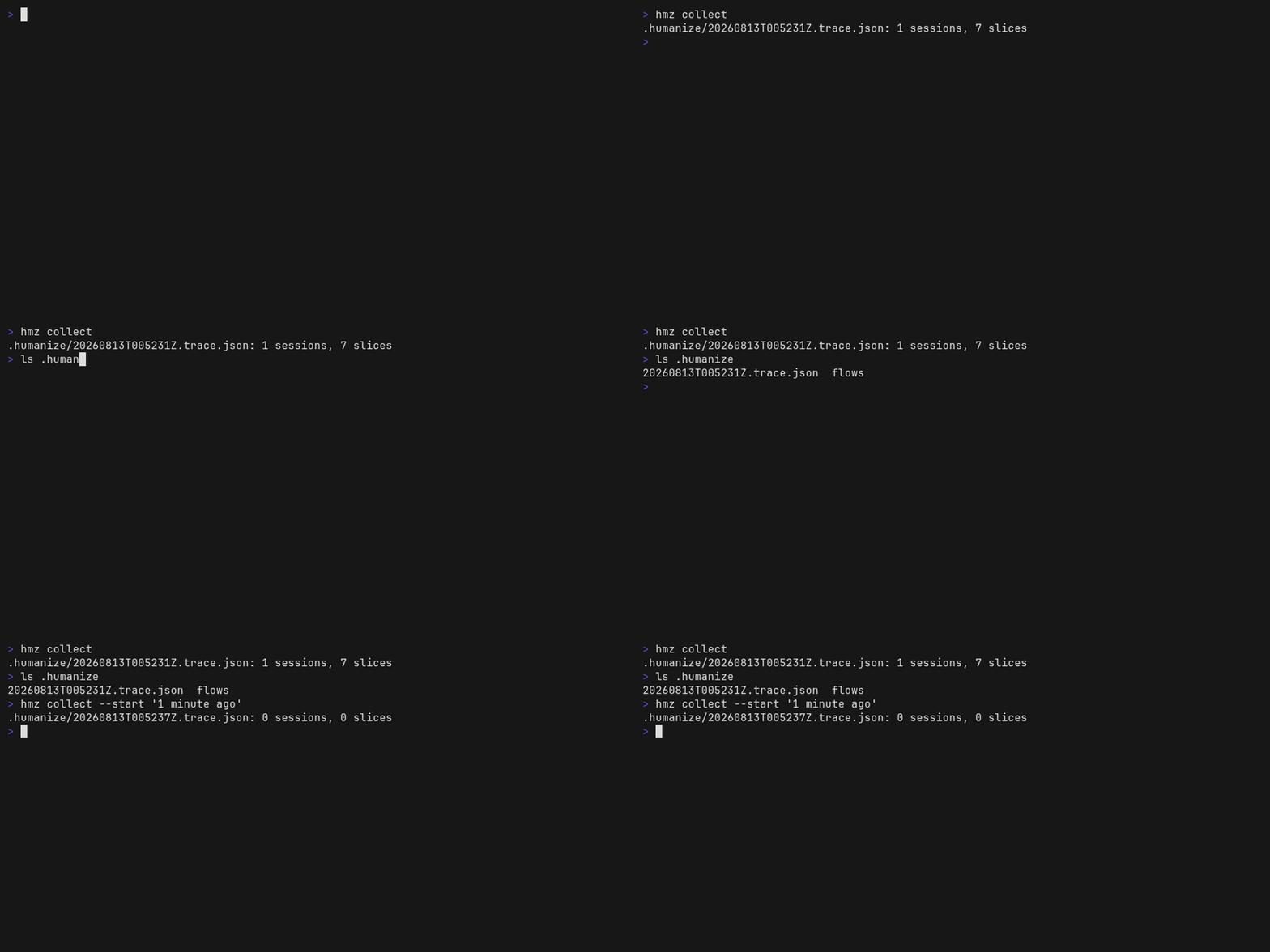
hmz collect.humanize/20260809T014455Z.trace.json: 3 sessions, 412 slicesDrag that file into ui.perfetto.dev, or load it in chrome://tracing. It is a Chrome JSON trace, so anything that reads one will do.
It works whether or not a flow drove them — a trace of yesterday's claude session is one command away.
What you get
process   agent          builder · claude-opus-4-8 · high
  track     session ──▶ ▓▓▓ ▓ ▓▓▓▓▓▓ ▓▓  ▓▓▓▓▓  ▓ ▓▓▓▓▓▓▓▓▓▓
  track     sub-agent ─▶      ▓▓▓▓▓▓▓▓▓▓▓
process   agent          reviewer · claude-opus-4-8 · high
track session ──▶ ▓▓▓▓ ▓▓▓▓ ▓▓▓▓| In the trace | Is |
|---|---|
| a process | one agent |
| a track | one session. Sessions of one agent that never run at the same time share a track; root sessions and sub-agents stay apart. |
| a slice | one action — a tool call, a message, or waiting for reasoning |
Click a slice and its arguments are there: the prompt, the reasoning, the tool input, the tool output. As much as the backend wrote down.
Why two agents do not read as one
The backends log a session under an id and never say whose it was. By default an agent in a trace is one configuration — a backend at a model at an effort — plus every sub-agent it started. So a Ralph loop of a hundred one-shot sessions reads as one agent, which is right; but an actor and a reviewer at the same model and effort would read as one agent, which is not.
That is what a cycle is for. hmz collect reads the last one in the workspace, so official/rlar traces as actor and reviewer without being told anything.
Driving agents by hand, say so yourself:
collect(agents={a.id: a.opened for a in (actor, reviewer)})Sessions nobody claims are read as the configuration they ran at.
What a run writes down
Every run of a flow is one cycle:
~/.humanize/cycles/<workspace>/<datetime>-<hex>.jsonlJSON lines, appended and flushed as it goes — so a run that died is a run whose cycle still says what it got to.
event | Written | Carries |
|---|---|---|
began | when the flow starts | flow, task, workspace, and one entry per agent with its id, backend, model and effort |
opened | each time an agent opens a session | agent, backend, session |
ended | when the flow stops | how: done, failed, or stopped |
It is not a transcript. The backend's own log is the turn-by-turn record; a cycle is the shape of the run — enough to gather a trace afterwards out of the ids alone.
An agent stopped by hand makes the run stopped rather than failed, whatever the turn under way made of it.
from hmz.cycle import cycles, opened

for cycle in cycles():                 # this workspace, oldest first
    print(cycle, opened(cycle))        # {"actor": ["0a1b…"], "reviewer": [...]}
Narrowing it
hmz collect                                    # this workspace, all of its history
hmz collect ~/code/other                       # another workspace
hmz collect --session 0a1b2c3d,5f6e            # two sessions, wherever they ran
hmz collect ~/code/other --session 0a1b2c3d    # that session, only if it ran there
hmz collect --start "3 days ago"               # recent history only
hmz collect --end "yesterday 18:00" --output /tmp/before.json- Naming sessions alone collects them wherever they were recorded.
- Adding a workspace keeps only the named sessions recorded there.
- Naming neither collects the current working directory.
A session is named by its whole id, by the key the trace shows it under, or by a leading part of either — and the sub-agents it started come with it. --start and --end take anything dateparser understands.
The default output is named after the UTC moment it was collected, so collecting twice keeps both.
Where it reads from
The backends' own home directories, which humanize only ever reads:
| Backend | Variable | Default |
|---|---|---|
| Claude Code | CLAUDE_CONFIG_DIR | ~/.claude |
| Codex | CODEX_HOME | ~/.codex |
| Kimi Code | KIMI_CODE_HOME | ~/.kimi-code |
Those three, and no others. opencode and mimocode keep a session in a database rather than in a log file, and nothing here reads pi's own log yet, so there is nothing to gather for any of the three: a run of theirs is watched as it happens rather than collected after.
A home that does not exist is skipped rather than being an error.
A pi home stops hmz collect altogether
hmz collect looks for a reader for every backend whose home exists, and there is none for pi — so with ~/.pi/agent (or $PI_CODING_AGENT_DIR) present it exits with KeyError: 'pi' rather than collecting the backends it can read. Collect with the variable pointed somewhere empty until that is fixed:
PI_CODING_AGENT_DIR=/nonexistent hmz collectA flow that ran on a machine of its own worked in a mirror rather than in this directory, so find its trajectories with --session rather than by workspace.
Watching instead
A trace is for after. While a run is going, /status shows the same shape live — and it is read off the turns going past, never by asking the flow.